Small and medium-sized enterprises (SMEs) play an important role in Europe’s industrial transition, developing technologies and implementing solutions that can reduce greenhouse gas emissions. However, accessing funding for climate innovation can be challenging, particularly for companies managing smaller investment projects or those without previous experience of applying for European Union grants.
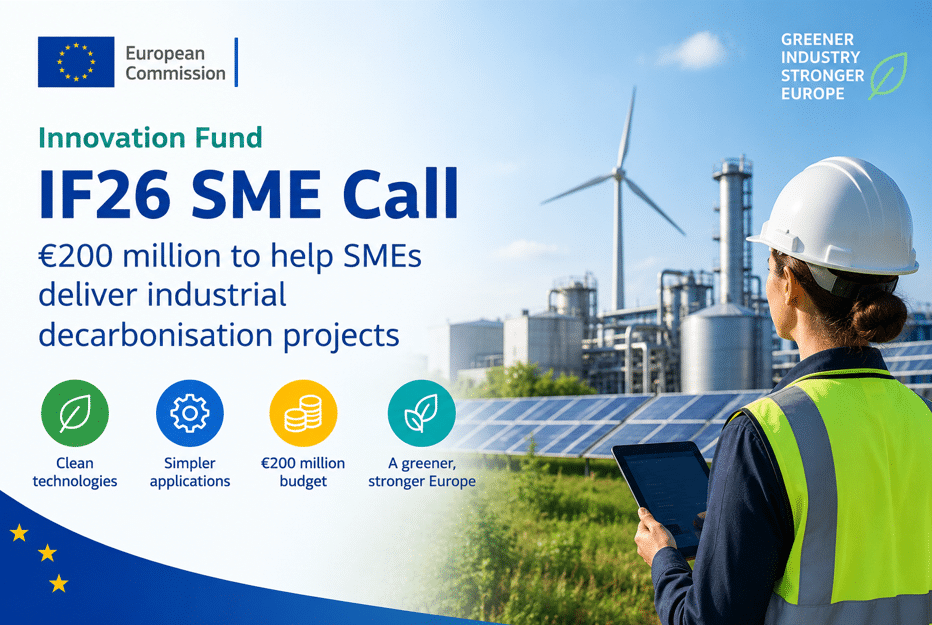
The Innovation Fund 2026 SME Call (IF26 SME Call) is being designed to address these barriers. With a planned budget of €200 million, the call will support small-scale projects with capital expenditure between €2.5 million and €20 million. Its objective is to make Innovation Fund funding more accessible to SMEs by simplifying application procedures, reducing reporting requirements and providing a more straightforward way to calculate climate benefits.
The initiative forms part of the European Commission’s wider effort to accelerate the deployment of innovative technologies that contribute to the EU’s climate objectives. Rather than requiring smaller businesses to navigate the same application process as larger industrial projects, the SME Call introduces a dedicated funding approach tailored to their needs.
The call is expected to be published in December 2026, with the first application deadline planned for the end of March 2027. A second application round is also planned, giving companies another opportunity to apply later in the year.
This article explains the objectives of the IF26 SME Call, its eligibility requirements, the planned simplifications, the application timeline and the main considerations for SMEs preparing a proposal.
What is the IF26 SME Call?
The IF26 SME Call is a planned funding opportunity under the EU Innovation Fund, specifically designed for SMEs undertaking smaller investment projects.
The Innovation Fund supports innovative technologies and solutions that contribute to reducing greenhouse gas emissions. The new SME Call seeks to extend access to this funding by creating an application process that is more proportionate to the size and needs of smaller businesses.
The European Commission has identified a particular challenge: SMEs may have promising projects but lack experience with EU grant applications. The administrative requirements involved in preparing an application, calculating climate benefits and complying with monitoring and reporting obligations can represent significant barriers for companies with limited resources.
The dedicated call aims to reduce these obstacles without abandoning the focus on climate impact. It will simplify the application process, introduce a semi-automated tool for calculating greenhouse gas avoidance, and make reporting and monitoring more straightforward.
The total budget is planned to be €200 million. This funding is intended for projects with capital expenditure ranging from €2.5 million to €20 million.
The call is therefore aimed at businesses whose projects require a meaningful investment but may be too small, or insufficiently suited to the application process, to benefit easily from other Innovation Fund calls.
The European Commission also intends the scheme to support projects that may carry more risk than those typically supported through other Innovation Fund calls. This feature could be relevant to innovative solutions whose development or deployment involves uncertainties, although applicants will still need to meet the requirements and evaluation criteria established for the call.
The IF26 SME Call should be understood as a dedicated funding opportunity within the Innovation Fund, rather than a separate programme unrelated to the EU’s broader climate policy. Its purpose is to make climate innovation funding more accessible to smaller businesses while supporting projects with the potential to deliver greenhouse gas reductions.
Who can apply?
The call is designed specifically for small and medium-sized enterprises.
What is the eligible project size?
The IF26 SME Call will support small-scale projects with capital expenditure between €2.5 million and €20 million.
This investment range is central to determining whether a project fits the call. SMEs considering an application should assess the capital expenditure associated with the proposed project and compare it with the applicable limits.
The project must also meet the call’s substantive requirements, including the relevant climate objectives and eligibility conditions. Meeting the SME definition and investment threshold alone does not guarantee eligibility or funding.
Can companies apply as a consortium?
Yes, consortium applications are possible, but all consortium members must be SMEs.
This condition is important for businesses planning to collaborate with technology developers, industrial operators or other organisations. Before choosing a consortium structure, applicants should verify that every member meets the applicable SME definition.
Larger companies with small-scale projects are not intended to use this dedicated SME call. According to the European Commission, they can instead apply through other Innovation Fund calls where their projects meet the relevant requirements.
This distinction makes it important to assess both the size of the company and the scale of the investment before deciding which funding opportunity to pursue.
About the author of this post

Sara Gavidia
Communications Manager
Funding Expert
LinkedIn
sara.gavidia@strata.team
Hello! I’m Sara 👋🏻 I’m the Lead content editor at Strata. Interested in the Innovation Fund? Then contact our Team of experts: they will offer personal support to review your case and help you prepare a great application!