Industrial heat is a major challenge in Europe’s transition towards climate neutrality. Manufacturing processes in sectors such as chemicals, steel, food and beverages, pulp and paper, and cement require substantial amounts of energy at medium and high temperatures. Replacing fossil-fuel-based heat with cleaner alternatives is therefore an important step towards reducing industrial emissions while strengthening Europe’s energy resilience.
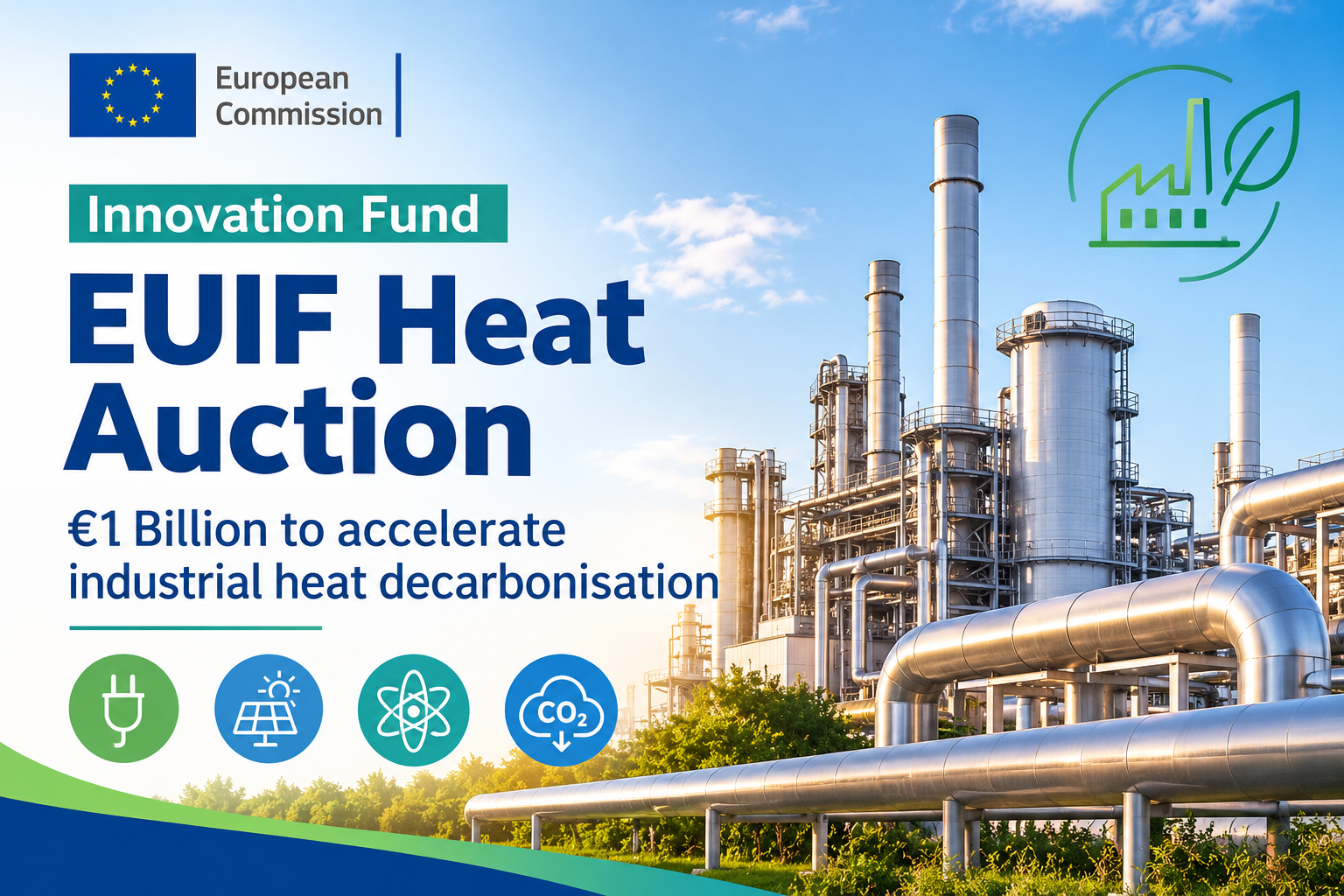
The European Union is addressing this challenge through the Innovation Fund 2026 Heat Auction (IF26 Heat Auction), a funding mechanism designed to accelerate the deployment of innovative technologies for industrial process heat. Announced as part of the European Commission’s Clean Industrial Deal, the second edition of the auction is planned to launch in December 2026, with a budget of €1 billion financed through the auctioning of EU Emissions Trading System (EU ETS) allowances.
Building on the experience of the pilot auction, the new edition broadens the range of eligible technologies, expands access to applications involving lower-temperature heat, and strengthens incentives for flexibility solutions that can reduce pressure on the electricity system.
This article covers:
- The objectives of the IF26 Heat Auction and its role in industrial decarbonisation.
- The technologies and industrial applications targeted by the initiative.
- How the funding mechanism works and which projects can apply.
- The main changes introduced in the second edition.
- The results of the first Heat Auction and what they reveal about industrial demand.
- The timeline and practical considerations for potential applicants.
What is the IF26 Heat Auction?
The IF26 Heat Auction is an initiative implemented through the EU Innovation Fund to support the decarbonisation of industrial process heat. Its planned €1 billion budget will be financed by revenues from the auctioning of EU ETS allowances, connecting the EU’s carbon-pricing framework with investment in cleaner industrial technologies.
Unlike a conventional grant scheme that reimburses a proportion of eligible project investment costs, the Heat Auction uses a competitive bidding mechanism linked to emissions reductions. Successful bidders receive a fixed premium subsidy proportional to each tonne of direct CO₂ emissions avoided, for a maximum period of five years.
This structure is intended to support the deployment of cleaner heat technologies while rewarding the emissions reductions achieved by participating projects. By providing a defined period of financial support, the auction can help industrial operators assess the economic viability of replacing fossil-fuel-based heat with low-carbon alternatives.
The initiative is open to projects of all sizes and industrial sectors across the European Economic Area (EEA). This broad scope allows companies with different production processes and energy requirements to explore solutions adapted to their operations.
The auction also reflects a wider industrial policy objective. The European Commission presents it as a means of increasing investment in homegrown clean energy solutions, improving resilience, and helping reduce energy prices. Its design recognises that industrial decarbonisation is not only a matter of replacing one energy source with another: the transition must also account for the reliability of industrial processes and the demands that new technologies place on electricity infrastructure.
Which technologies and projects are supported in the IF26 Heat Auction?
The second Heat Auction supports innovative technologies across three main categories.
Electrified heat technologies
The first category includes technologies that use electricity to generate or supply industrial heat. Examples identified by the European Commission include:
- Heat pumps.
- Thermal storage.
- Plasma torches.
- Electric boilers.
These technologies offer different ways of meeting industrial heat requirements. Electric boilers and other electrical heating systems can supply heat directly, while heat pumps can provide heat by transferring energy from a source to a higher temperature. Thermal storage can help separate the timing of heat production from the timing of heat consumption, potentially allowing industrial operators to make better use of electricity when it is available or when system conditions are more favourable.
The suitability of each option depends on the temperature required, the industrial process, and the configuration of the facility.
Direct renewable heat
The second category covers direct renewable heat, including solar thermal and geothermal technologies.
These solutions can supply heat without relying on conventional fossil-fuel combustion. Their application depends on factors such as the availability of suitable renewable resources, the temperature requirements of the industrial process, and the integration of the technology into existing operations.
The inclusion of direct renewable heat is significant because industrial decarbonisation does not necessarily have to rely exclusively on electrification. Depending on the project, a direct renewable source may provide an alternative or complement to electrically generated heat.
Nuclear technologies, including small modular reactors
The IF26 Heat Auction introduces a further category: nuclear technologies, including small modular reactors (SMRs).
This is a notable expansion of the auction’s technological scope compared with the first edition. The European Commission identifies nuclear technologies as a new feature of the second auction, broadening the range of solutions that can be considered for industrial heat decarbonisation.
The inclusion of these technologies does not mean that every nuclear-based heat project will automatically qualify. Applicants will need to comply with the applicable Terms and Conditions and demonstrate that their proposals meet the scheme’s requirements.
Across all three categories, the central objective is to support innovative solutions capable of supplying industrial process heat while reducing direct CO₂ emissions.
How does the funding mechanism of the IF26 Heat Auction work?
The Heat Auction is based on a fixed-premium subsidy linked to emissions reductions. Successful bidders receive financial support proportional to each tonne of direct CO₂ emissions abated, for a maximum period of five years.
The competitive auction format makes the proposed level of support an important part of a project’s bid. Applicants must consider the relationship between the financial support requested, the emissions reductions their project is expected to achieve, and the practical conditions under which the new heat solution will operate.
The scheme’s focus on direct CO₂ emissions is particularly relevant when assessing projects that replace existing fossil-fuel-based heat production. The emissions-reduction calculation and other applicable requirements must follow the official Terms and Conditions rather than assumptions made by individual applicants.
The auction is open to projects of all sizes and industrial sectors across the EEA. It is intended for industrial processes that operate continuously, while also encouraging flexible solutions that avoid electricity consumption during peak hours or use technologies that do not require electricity.
This combination of a broad eligibility scope and a competitive funding model allows the auction to address different industrial needs without limiting participation to a single technology or manufacturing sector.
The scheme may also receive additional funding from national contributions through the EU’s Auction-as-a-Service mechanism. This approach allows participating countries to contribute national resources alongside the EU-level auction. The European Commission notes that the mechanism has already been used successfully in previous hydrogen auctions.
However, a potential national contribution should not be confused with a guaranteed additional allocation. The availability of such funding depends on whether national authorities choose to participate and on the applicable arrangements.
For prospective applicants, the final Terms and Conditions are the essential reference for determining eligibility, preparing a bid, and understanding the detailed requirements attached to the funding.
What has changed in the second edition of the IF26 Heat Auction?
The IF26 Heat Auction builds on the pilot auction while introducing several changes intended to widen participation and improve the integration of clean heat technologies into industrial energy systems.
Lower-temperature heat applications. The second edition expands eligibility to include certain projects using heat from temperatures as low as 80°C. This opens the door to industrial applications that may not require the higher temperatures associated with more energy-intensive manufacturing processes.
A broader technology scope. The inclusion of nuclear technologies, including small modular reactors, adds another option to the technologies considered by the auction. Electrified solutions and direct renewable heat remain central to the initiative.
Greater emphasis on flexibility. The new edition provides further incentives for flexibility solutions that reduce pressure on the electricity system. This is relevant for industrial facilities that need to maintain reliable heat supplies while adapting electricity consumption to system conditions.
Continued support across sectors and project sizes. The auction remains open to projects of all sizes across industrial sectors throughout the European Economic Area. This approach allows the funding mechanism to address a variety of industrial processes rather than concentrating on a single type of company or technology.
The final Terms and Conditions were published on 24 September 2026, following stakeholder consultation and a consultation event in July. This process provided an opportunity for industry representatives and other stakeholders to contribute to the development of the auction’s design.
Together, these changes indicate that the second edition seeks to extend the reach of industrial heat decarbonisation while addressing the practical challenges associated with electrification and energy-system flexibility.
Background: What did the first Heat Auction achieve?
The results of the Innovation Fund 2025 Heat Auction provide a useful indication of the demand for funding to decarbonise industrial heat.
According to the results published in May 2026, the pilot received 85 proposals requesting approximately €1.235 billion in funding. Of these, 69 were considered admissible and eligible, and 65 were selected. The total funding allocated to selected proposals amounted to approximately €396.5 million.
The results demonstrate that industrial companies submitted proposals across a range of temperature requirements, technologies, and industrial sectors.
Funding allocation by temperature category
The first auction divided projects into three categories:
| Category | Available budget | Selected proposals | Funding selected |
| High temperature | €500 million | 5 | €62 million |
| Medium temperature above 5 MW | €350 million | 44 | €287 million |
| Medium temperature, 3–5 MW | €150 million | 16 | €48 million |
| Total | €1 billion | 65 | €397 million |
Source: Innovation Fund 2025 Heat Auction Results Publication, May 2026. Figures are rounded.
The medium-temperature category above 5 MW accounted for the largest number of selected projects and the largest share of the funding awarded. It attracted 53 proposals, of which 44 were selected.
The high-temperature category received 13 proposals, with five selected. The smaller medium-temperature category received 19 proposals, of which 16 were selected.
These results show that the first auction attracted interest across all three categories, although the number of selected proposals and the funding allocated varied considerably.
Which industrial sectors participated?
The pilot covered a broad range of industrial activities. The selected projects included applications in chemicals, food and beverages, glass and ceramics, construction materials, iron and steel, pharmaceuticals, pulp and paper, refineries, textiles, and other sectors.
Pulp and paper was a particularly significant sector in the results. Sixteen proposals were selected, representing approximately €129.9 million in funding. The chemicals sector accounted for 13 selected proposals and approximately €90.2 million. Food and beverages accounted for 14 selected proposals and approximately €58.8 million.
The results illustrate how industrial heat decarbonisation can apply to different manufacturing environments, each with its own operating conditions and heat requirements.
Where were the selected projects located?
The 65 selected projects were distributed across several European countries.
Spain recorded 24 selected projects, representing approximately €135.6 million in funding. France followed with 21 selected projects and approximately €100.6 million. Other selected projects were located in Belgium, Germany, Portugal, Denmark, Czechia, Slovenia, Austria, and Hungary.
Spain and France therefore accounted for the largest numbers of selected projects and the largest funding allocations in the published results.
The geographical distribution also demonstrates that the pilot attracted proposals from across the European industrial landscape, rather than being limited to a small number of participating countries.
Which technologies were selected?
The results publication identified electric heating technologies as prominent solutions, particularly in the medium-temperature categories. Direct resistance heating was used in 18 selected projects in the medium-temperature category above 5 MW and seven projects in the 3–5 MW category. Indirect resistance heating accounted for another 15 and seven selected projects, respectively.
Heat pumps were represented by five selected projects in the category above 5 MW and two in the smaller medium-temperature category. Solar thermal technologies appeared in two selected projects in the category above 5 MW.
In the high-temperature category, the results publication highlighted the use of different types of furnaces.
The findings provide a snapshot of the technologies proposed under the pilot. They should not be interpreted as a forecast of which technologies will dominate the second edition, whose scope is broader and explicitly includes nuclear technologies.
Overall, the first auction established a practical starting point for competitive funding of industrial heat decarbonisation. The IF26 edition builds on that experience while expanding the opportunities available to prospective applicants.
Timeline and preparation for applicants
The European Commission has published the following timeline for the IF26 Heat Auction:
- May 2026: Publication of the draft Terms and Conditions for stakeholder consultation.
- July 2026: Stakeholder consultation event.
- 24 September 2026: Publication of the final Terms and Conditions.
- October 2026: National information webinars.
- December 2026: Planned opening of the call for proposals.
- February 2027: Planned closure of the call.
The call is therefore planned to open in December 2026 and close in February 2027. Applicants should consult the official European Commission page for updates and the definitive application requirements.
National information webinars are being organised throughout October 2026 through the Innovation Fund National Contact Points. The published schedule includes sessions for Ireland, Romania, Spain, the Nordic countries, Italy, Germany and Austria, the Netherlands, Belgium and Luxembourg, Czechia and Slovakia, and France. Attendance is open to all.
These webinars offer a useful opportunity for interested companies to learn more about the auction and ask questions before submitting a proposal.
For companies considering an application, preparation should begin with a clear assessment of the industrial process and the proposed heat solution. Potential applicants should establish whether their project falls within the eligible scope, identify the temperature requirements of the process, and assess how the proposed technology could reduce direct CO₂ emissions.
They should also consider the operational implications of the project. For example, a company planning to electrify its heat supply may need to examine whether thermal storage or another flexibility solution could help manage electricity demand. A project using direct renewable heat will need to consider whether the technology can meet the relevant process requirements.
These are preparatory considerations rather than a substitute for the formal eligibility criteria. The final Terms and Conditions remain the authoritative reference for project requirements, bidding conditions, emissions calculations, and other obligations.
Conclusion
The IF26 Heat Auction represents a significant funding opportunity for European industry as manufacturers seek to reduce emissions from process heat. With a planned budget of €1 billion, the initiative combines competitive funding with an emphasis on measurable direct CO₂ emissions reductions.
Its expanded technological scope, inclusion of certain heat applications from 80°C, and stronger incentives for flexibility solutions distinguish the second edition from the pilot. The results of the first auction, which selected 65 proposals across multiple industrial sectors and European countries, demonstrate that there is already substantial interest in this funding approach.
For industrial companies, the opportunity lies in assessing how clean heat technologies can be integrated into existing manufacturing processes while meeting technical and operational requirements. The planned opening in December 2026 makes the final Terms and Conditions and the national information webinars important starting points for organisations considering a bid.
The Heat Auction is one component of the broader effort to make European industry cleaner and more resilient. Its effectiveness will ultimately depend on the quality of the projects submitted, their ability to deliver the expected emissions reductions, and the successful deployment of the selected technologies.
About the author of this post

Sara Gavidia
Communications Manager
Funding Expert
LinkedIn
sara.gavidia@strata.team
Hello! I’m Sara 👋🏻 I’m the Lead content editor at Strata. Interested in the Innovation Fund? Then contact our Team of experts: they will offer personal support to review your case and help you prepare a great application!