
The European Commission established the European Innovation Council (EIC) to help startups and SMEs scale up and develop disruptive technologies. With a budget worth more than €10 billion, this programme will run until 2027.
About the EIC Accelerator
The European Innovation Council (EIC) is Europe’s flagship innovation programme that identifies, funds, and scales up breakthrough technologies and game-changing innovations developed by startups and SMEs. Its focus is on high-risk high-impact projects, and it provides grants, convertible loans and equity investments.
This programme encourages high-risk investment to promote European autonomy in key inventions, boost European economic development, and create new R&D employment and social benefits. Nonetheless, its process is highly selective, and success rates range from 2 to 6%.
Budget for the EIC Accelerator
In order to support disruptive technologies, the EIC Accelerator has a budget of €634 million in 2026. The EIC STEP Scale Up call offers a total indicative budget of €300 million for 2026, which is expected to rise to €900 million for the period 2025-2027.
EIC Accelerator Schemes
There are two schemes:
- EIC Accelerator Open: it accepts proposals in any field of technology, therefore, there is no predefined topic. It seeks to assist businesses where the funding from the EIC will serve as a catalyst to attract additional investors required for the invention to be scaled up.
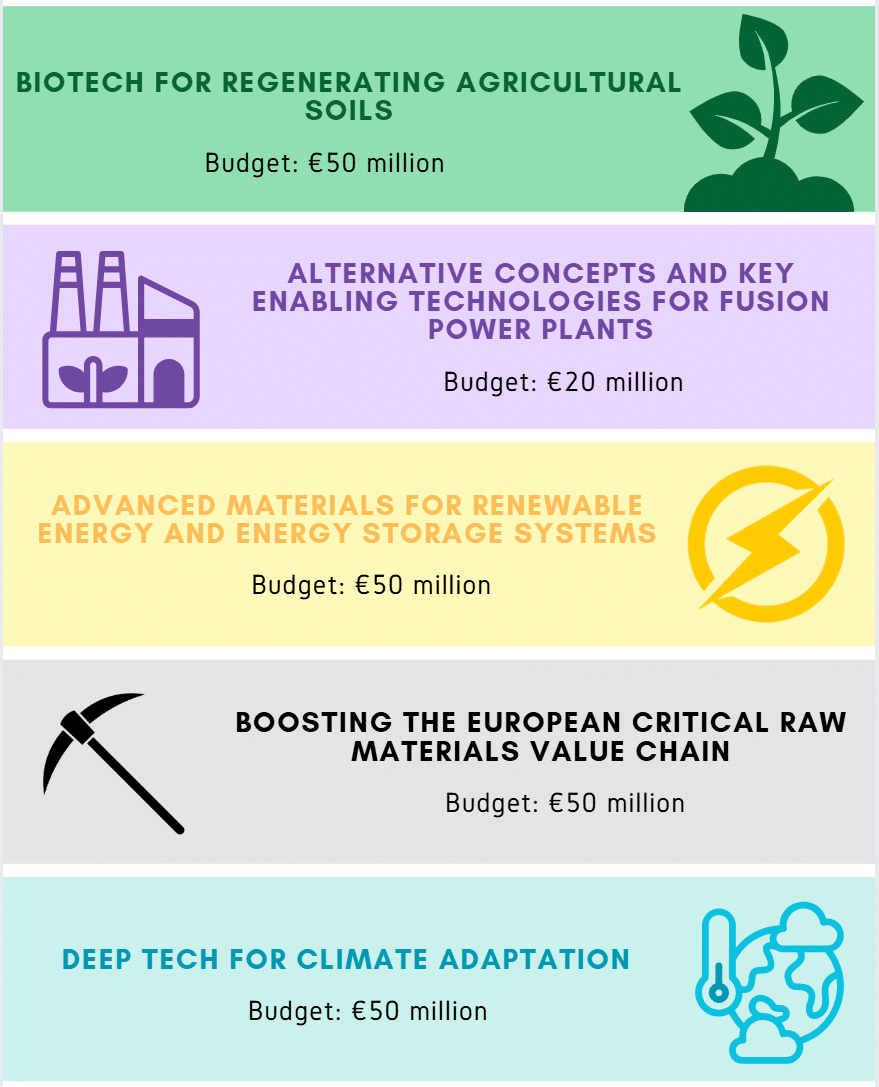
- EIC Accelerator Challenges: it has a budget worth €250 million in 2025, and it is focused on areas where innovative ideas or ground-breaking technology created by SMEs or startups may contribute to reaching the EU goals.
Funding options available for the EIC Accelerator
Since 2025, there are two funding options for the EIC Accelerator:
- Grant funding: up to €2.5 million to carry out activities within TRL6 to TRL8. It covers innovation activities, including demonstration of the technology in the relevant environment, prototyping and system level demonstration, R&D and testing required to meet regulatory and standardization requirements, intellectual property management, and marketing approval.
- Equity or quasi-equity investment: up to €10 million for market deployment and scale-up in the form of direct equity investments of convertible loans.
Who can apply for the EIC Accelerator?
- A single start-up or SME (including spin-outs) established in an EU Member State or Horizon Europe (HE) Associated Country,
- A ‘Small mid-cap’ (up to 499 employees) established in an EU Member State or HE Associated Country, but only for investment-only or for “blended finance” in exceptional cases for rapid scale up purposes;
- One or more natural persons or legal entities willing to set up a SME.
As the European Innovation Council has recently published its 2025 Work Programme, we at Strata have created the EIC Accelerator Guide 2025 with the most important novelties.
EIC Accelerator changes and novelties for 2026
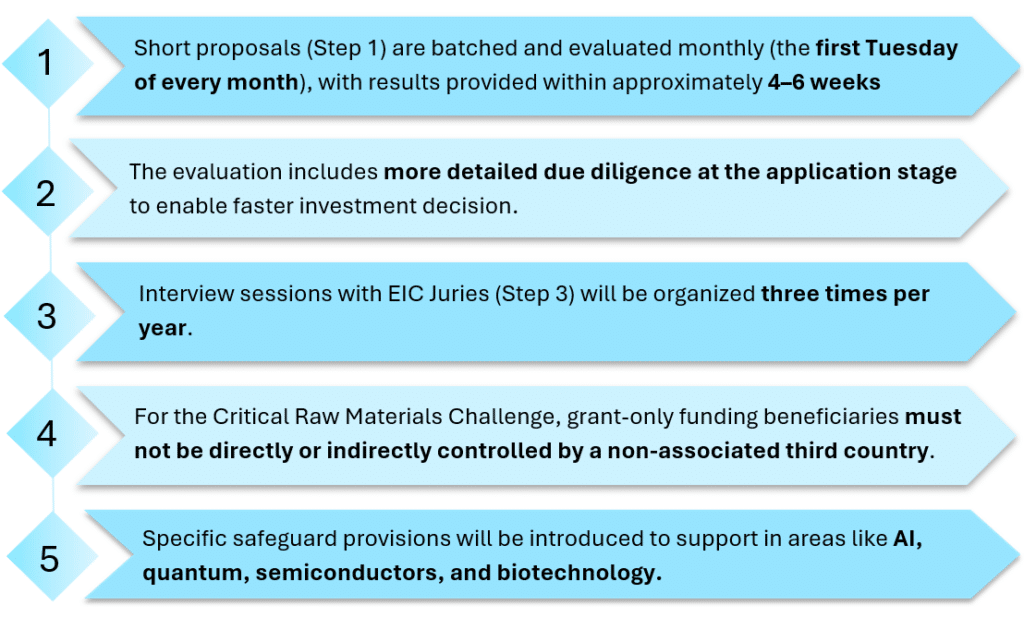
- Short proposals (Step 1) are batched and evaluated monthly (the first Tuesday of every month), with results provided within approximately 4–6 weeks.
- The evaluation includes more detailed due diligence at the application stage to enable faster investment decision.
- Interview sessions with EIC Juries (Step 3) will be organized three times per year.
- For the Critical Raw Materials Challenge, grant-only funding beneficiaries must not be directly or indirectly controlled by a non-associated third country.
- Specific safeguard provisions will be introduced to support in areas like AI, quantum, semiconductors, and biotechnology.
The EIC Accelerator supports high-impact innovations with the potential to create new markets or disrupt existing ones globally.
Catalytic Role: The support is explicitly designed to act as a catalyst to crowd in other necessary investors for the innovation’s scale-up in a shorter timeframe.
Targeted Innovation (Deep Tech): It focuses particularly on innovations built on scientific discovery or technological breakthroughs (deep tech). Deep tech innovations are often high-risk, require significant funding over a long timeframe (“patient capital”), and struggle to attract adequate private financing alone.
Stage of Development (TRL): The Accelerator supports the later stages of technology development and scale-up. The technology component must have been substantially de-risked and validated in a relevant environment, requiring applicants to have completed at least Technology Readiness Level (TRL) 5. Grant funding covers innovation activities typically spanning TRL 6 to TRL 8.
Download our guide for free
If you want to know more about the application process for the EIC Accelerator for 2026, learn about its novelties in detail, and access Strata’s unique advice and offering, download our guide filling in this form: